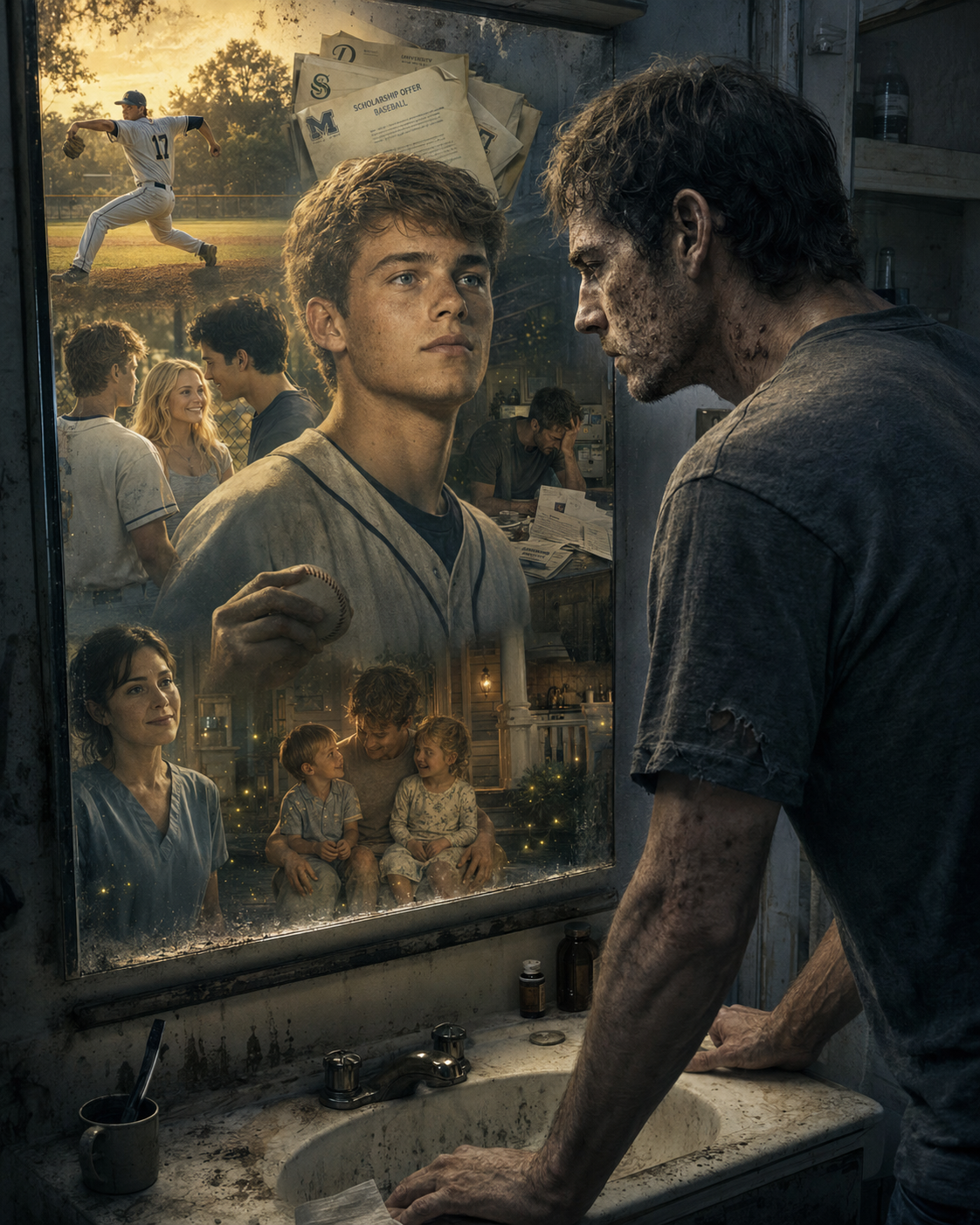
The Life He Chose
At seventeen, Roger looked like the kind of boy adults pointed to when they wanted to lecture their own children about potential. “Why can’t you apply yourself like Roger?” He heard it more times than he could count.
Roger was six foot two before his junior year of high school, all long arms and lean muscle. He wasn’t bulky like the football players who lumbered through the halls of Bryant High. He was wiry and strong, built like a whip. His sandy brown hair curled at the edges when it got too long, and his blue eyes made people trust him before he ever opened his mouth.
Teachers loved him. Coaches adored him. Girls wanted him. He was the golden boy, and Roger knew it. Not in an arrogant way. He simply understood what had been laid out in front of him. A full academic scholarship was practically guaranteed. His ACT scores were already high enough that colleges had started sending letters every week. On top of that, two baseball coaches had promised him that if he kept pitching the way he did, he would have a place on their rosters.
“Your fastball is money,” Coach Dawson told him after one spring game. “You keep your head on straight, son, and there isn’t a limit to where you can go.” Roger believed him. He believed in hard work, loyalty, and more than anything; he believed in Christy.
Christy was barely five feet tall, with honey-blonde hair that fell halfway down her back and a smile that could convince Roger to do almost anything. She looked delicate, but there was a stubborn streak in her that made him love her even more.
Benjamin had been Roger’s best friend since third grade. Where Roger was tall and sunlit, Benjamin was medium height and broad-shouldered, with dark hair, olive skin, and brown eyes that made him look older than he was. The three of them were inseparable.
“You two are disgusting,” Benjamin said one Saturday night when Roger and Christy wouldn’t stop kissing during a movie.
Roger grinned. “Jealous?”
Benjamin scoffed, “Of your cooties? Hard pass.” Christy laughed and threw popcorn at him. Roger would later replay moments like that and wonder if the signs had always been there.
But back then, his life seemed almost perfect. Until Christy told him she was pregnant.
Roger sat in his truck behind the baseball field, gripping the steering wheel so tightly his knuckles turned white. “What do you mean pregnant?”
Christy twisted her hands in her lap. Tears filled her eyes. “I’m eight weeks late.”
The panic hit him first. Then fear. Finally, resolve. He turned toward her and took both her hands. “Okay.”
Christy blinked. “Okay?”
“Yeah.” His voice shook, but he held her gaze. “We’ll figure it out.”
She sighed, “You’re not mad?”
“Terrified,” he admitted. “But this is my child, Christy. And I love you.” She burst into tears and fell into his arms.
That summer, Roger worked harder than he ever had. He poured concrete in the blistering heat, unloaded feed at the co-op, and mowed lawns on weekends. Every dollar went toward doctor visits, baby furniture, and boxes of diapers stacked in the corner of Christy’s bedroom.
Benjamin stayed close through all of it.
“You’re a better man than most grown adults,” Benjamin said one night as they loaded a crib into Roger’s truck.
Roger wiped sweat from his forehead. “I’m just doing what needs to be done.”
Benjamin looked away. “Yeah.” Roger didn’t understand why his friend sounded so sad.
By the time school started and he started his senior year, Roger had given up baseball. Coach Dawson called him into his office a week before school started. The walls were lined with team photos and plaques, each one representing a boy who had gone on to play college ball. Roger had always imagined his own picture hanging there one day. “I need you to think long and hard about what you’re doing,” Coach Dawson said.
“I have,” Roger retorted, already tired of this conversation he’d had multiple times.
“You’re one of the best pitchers I’ve coached in twenty years,” Coach Dawson urged.
Roger gave a humorless smile. “That doesn’t help me buy formula.”
“Scholarships do.” Dawson leaned forward. “You don’t have to throw your future away because life got complicated.”
Roger’s jaw tightened. “I’m not throwing it away. I’m taking responsibility.”
Coach Dawson studied him for a long moment. “There’s a difference between responsibility and sacrifice, son. Sometimes people let you sacrifice everything while they give up nothing.”
Roger frowned. “Christy isn’t like that.”
Coach Dawson looked at him with resigned eyes. “I hope you’re right.”
Roger walked out irritated, convinced that adults simply didn’t understand what it meant to love someone enough to put them first.
In September, Christy asked him to meet behind the gym after football practice. Her voice sounded strange and she could barely look him in the eyes.
“Everything okay?” Roger asked.
She looked down, twisting her fingers together. “Just come.”
When Roger pulled into the parking lot, Benjamin’s truck was already there. Christy stood near the fence with her arms wrapped around herself. Benjamin hovered beside her, hands shoved deep in his pockets. Roger climbed out slowly. “What’s going on?” Christy began crying before she spoke. Roger turned to Benjamin. “Ben?”
Benjamin wouldn’t look at him. Christy took a shaky breath. “Roger…the baby isn’t yours.”
The world didn’t explode. That would have been kinder. Instead, it went quiet. Roger laughed once, sharp and disbelieving. “What?”
“I’m sorry,” Christy sobbed.
Roger stared at Benjamin. His best friend finally lifted his eyes. “I never meant for this to happen,” Benjamin said.
Roger felt as though someone had hit him in the chest with a bat. “No.”
“It was just supposed to be once,” Benjamin said. “Then it happened again.”
Roger’s voice rose. “When? In my truck? In my house? While I was working double shifts to buy a crib?” Benjamin flinched.
Christy reached for him. “Roger, please—”
He jerked away from her touch. “How long?” Neither answered. Roger laughed again, this time with tears in his eyes. “Every time you told me you loved me.” The crib, the diapers, the scholarship letters stacked on his desk; the summer he had spent working until his hands bled, all of it stared him in the face. Every sacrifice, every promise, all of it built on lies.
“I would have done anything for you,” he whispered.
Benjamin stepped forward. “Roger…”
Roger swung and landed a punch square in Benjamin’s jaw, sending him backward. “Don’t say my name.” He climbed into his truck and drove away before either of them could stop him. He watched as the future he thought he was building toward grew smaller in his rearview mirror.
For nearly two hours, he drove with the windows down, hot September air whipping through the cab while Christy’s words played again and again in his head. “The baby isn’t yours.” He finally pulled onto a dirt road outside of town and killed the engine. The silence was deafening. Roger bowed his head over the steering wheel. At first, he tried not to cry. Then the sobs came so hard he could barely breathe.
“I did everything right!” he shouted to the empty fields. His voice cracked. “I did everything right.” But doing the right thing had not protected him.
When Roger came home, his mother met him at the door. “Roger, where have you been? Christy called…”
“She’s pregnant with Benjamin’s baby,” Roger replied dejectedly.
His mother covered her mouth. “Oh, honey.” Roger walked past her without another word, went to his room, and shut the door.
His stepfather found him later sitting on the edge of his bed in the dark. “You still have school tomorrow,” his stepfather said.
Roger let out a hollow laugh. “Why, Dave?”
“Because your life isn’t over,” David explained softly.
Roger looked at him with dead eyes. “It feels like it is.”
David put a hand on Roger’s shoulder. “Then you get up anyway.”
But some wounds were deeper than determination. Within a week, Roger stopped going to school. Coach Dawson came by and tried to talk sense into him.
“Transfer if you need to,” he said. “Finish somewhere else. Go to college. Pitch. Build a better life.”
Roger shook his head. “I can’t.”
“Yes, you can,” Coach Dawson urged.
“Everywhere I go, they’ll be there,” Roger whispered as the pain crashed over him again.
Coach Dawson’s face softened. “Then let them watch you succeed. Show them how much they lost when they lost you.”
Roger wanted to believe him, but the heartbreak had become heavier than hope. A week later, he signed the withdrawal papers. With one signature, the golden boy disappeared.
The first cigarette tasted like burning paper and regret. Roger coughed so hard he nearly threw up. His cousin Brad laughed and slapped him on the back. “You get used to it.” Roger took another drag. He wanted to hate it. Instead, he welcomed the sting in his lungs because it drowned out the ache in his chest.
The smoking led to drinking. The drinking led to weed. The weed led to whatever someone offered him at a party, behind a gas station, or through the cracked window of a stranger’s car. For the first time in his life, Roger stopped caring where he was going.
In October, when Christy gave birth to Benjamin’s son, Roger sat on the tailgate of his truck in a hospital parking lot with a six-pack between his boots. He stared at the glow of the hospital sign and imagined the life he had built in his head. A tiny baseball glove hanging from a crib. Saturday mornings at the ball field. Christy in the bleachers, smiling at him. He crushed the empty can in his hand until the aluminum split against his palm. “Congratulations,” he muttered to the night. Then he opened another beer.
Roger ran to his grandparents in Oklahoma under the excuse of needing a fresh start. For a while, their small house felt safe. His grandmother cooked biscuits and gravy every morning. His grandfather let him ride along to the feed store and never asked too many questions.
Roger told himself he was healing. But healing and hiding were not the same thing.
A year passed before his grandfather finally sat across from him at the kitchen table. “Son, we love you.”
Roger looked up from his plate. “I know.”
His withered face held all the compassion someone with so many years behind them could muster. “But love doesn’t mean helping you waste your life.” Roger’s stomach tightened. “You’ve been here a year,” his grandfather continued. “You don’t have a plan. You barely work. You spend your nights with people headed nowhere.”
Roger interrupted him, “So, you’re kicking me out.”
He reached across the table to take Roger’s hands. “I’m telling you it’s time to decide what kind of man you want to be.”
Roger laughed bitterly, pulling his hands away. “That ship sailed.”
His grandfather’s blue eyes hardened. “No, son. You’re just choosing not to board it.”
Two weeks later, Roger left with a duffel bag, a handful of cash, and resentment he disguised as indifference.
By twenty, the transformation was impossible to ignore. Roger was still tall, but he had become painfully thin. His shoulders looked sharp beneath his T-shirt. His teeth had yellowed and begun to chip. Small scars and pockmarks dotted his cheeks. His eyes, once bright and confident, now carried a restless, hunted look.
Eventually, his Aunt Adda and Uncle Eddie found him sleeping in his truck outside a convenience store. Adda burst into tears. “Roger, look at you.”
He tried to joke. “I’ve had better days.”
Uncle Eddie opened Roger’s door. “Scoot over.”
Roger glared at him. “I’m fine.”
Eddie’s expression never changed. “No, you’re not. You’re coming home with us. I’ll drive your truck. Adda can follow behind. Now scoot.” His eyes and voice left no room for argument.
Three weeks later, Roger checked into rehab. He hated it at first. He hated the fluorescent lights, the lukewarm coffee, the folding chairs, and the forced honesty. Most of all, he hated the mirrors. Every morning, he saw a ghost of the boy he used to be.
One day, as he glared at his reflection, a woman’s voice sounded behind him. “You know, if you keep looking at yourself like that, the mirror’s liable to crack.” Roger turned. She stood in the doorway wearing navy scrubs and a stethoscope. Her name badge read: Becky Sullivan, RN.
She was short, barely five foot four, with dark brown hair, green eyes, and an easy confidence that made her seem taller. She was very pretty, but not in the fragile way Christy had been. Becky was full-figured, grounded, and steady, as if life had given her enough weight to anchor anyone standing too close.
Roger snorted. “The mirror would win.”
“Maybe,” she said. “But I’ve seen worse cases than you.”
“Congratulations,” he snarked back at her.
She folded her arms. “You always this charming?”
“Only before coffee,” he mumbled, turning away from the mirror altogether. A smile tugged at her lips, and for the first time in years, Roger felt something akin to hope.
Over the next several weeks, Becky became the part of rehab Roger looked forward to most. Sometimes she checked his vitals. Sometimes she sat with him in the common room after her shift ended. Sometimes they just talked.
She asked him about baseball. “You pitched?”
“Pretty well,” he hedged.
She quirked an eyebrow. “How well is ‘pretty well’?”
Roger shrugged. “Scholarships. Scouts. The whole deal.”
Becky studied him. “You talk about it like it happened to someone else.”
He stared at his fingernails before answering. “Feels that way.”
“What happened to him?” she asked softly.
Roger laughed bitterly. “A girl, a baby, and a best friend.”
“That’ll do it.” Her matter-of-fact tone surprised him. “Life doesn’t break us in original ways, Roger,” she said softly. “It just convinces us our pain is unique.” He thought about that long after she left.
When Roger completed treatment, Becky met him in the parking lot. He carried a duffel bag and a stack of discharge papers. His hands shook, not from withdrawal this time, but from fear. “What now?” he asked.
She grinned at him. “Now you go build a life.”
A ghost of his past passed through him. “And if I screw it up?”
She stepped closer. “Then you get up and keep going.”
He swallowed hard. “Would you maybe want to get dinner sometime?”
Becky smiled. “I was wondering how long it would take you to ask.”
The next year became the happiest Roger had ever known. He stayed clean. Through Uncle Eddie, he landed a steady job operating a backhoe for a construction company. The work was hard, but Roger liked the feel of heavy machinery responding to his hands. There was comfort in moving earth and shaping foundations.
He gained weight. His face filled out. A dentist repaired his worst teeth. Though the pockmarks remained, Becky kissed his cheeks as if they were part of a map she had memorized.
They married in a small church with family and a few close friends. When their first child, a son named Ken, was born, Roger cried so hard Becky laughed through her own tears.
“You’re supposed to be the tough one,” she whispered.
Roger held his son against his chest. “I don’t think I’ve ever been this scared.”
“That means you understand how much he matters,” she replied with all the joy a new baby brings. Two years later, their daughter Rileigh arrived.
Their house was small. Their cars were used. Money was tight. But on summer evenings, Roger sat on the porch with Becky tucked against his side while their children chased lightning bugs through the yard. For four years, Roger believed he had been saved. Then he began making excuses again. At first, they sounded harmless. “I’m just tired.” “Work has been brutal.” Roger repeated the lines often enough that he almost believed them.
Backhoe work paid well, but the hours were long and unpredictable. One week he worked sixty hours; the next, rain shut everything down and his paycheck came up short. Becky made good money as a nurse, but between the mortgage, daycare, groceries, car payments, and all the little expenses that came with two children, every dollar disappeared before it touched their account.
One Friday evening, Becky stood at the kitchen counter with bills spread around her. Her dark hair was pulled into a messy bun, and faint circles sat beneath her green eyes. “We’re overdrawn again,” she said quietly.
Roger loosened his work boots. “I’ll pick up overtime.”
Her shoulders drooped. “You’ve already worked three Saturdays this month.”
“So, what’s your solution?” The words came out sharper than he intended.
Becky flinched. “My solution,” she said after a long pause, “is that we stop pretending everything is fine.” Roger looked away because everything was not fine.
For two months, he had been using again. Not every day. Just enough to quiet the buzzing in his head. Just enough to feel capable. Just enough to convince himself he deserved relief. The lies sounded familiar because he had told them before. And, like before, it grew.
Soon, overtime checks disappeared faster than Becky could account for them. Roger became moody and distant. He stayed out later. He snapped at the kids for making noise. He avoided mirrors because he recognized the man staring back at him. He knew exactly where the road led, but he drove down it anyway.
Roger met Katelyn at a convenience store on the edge of town. She had just turned eighteen and worked the evening shift behind the register. Katelyn was the opposite of Becky in nearly every way. She was a large young woman with stringy bleached hair, a pockmarked face, and teeth stained from years of smoking and too much soda. Her laugh was loud, her eyeliner uneven, and her choices were almost as reckless as Roger’s. But she looked at him with open admiration.
“You’re kinda hot for an older guy,” she said one night as she handed him his change.
Roger laughed despite himself. “I’m twenty-six.”
“Ancient,” she giggled.
The attention fed something hungry inside him. With Becky, he felt like a disappointment. With Katelyn, he felt like a man worth wanting. That should have been a warning. Instead, Roger took it as permission.
The affair began in motel rooms and parked trucks. Roger told himself it meant nothing.
Then Katelyn called one afternoon. “I’m pregnant.”
He sat in the cab of his backhoe, staring at the controls. For a brief, terrible moment, he thought about Christy. About seventeen-year-old Roger working all summer to support a child he believed was his. About the devastation of betrayal. About the vows he had made never to become the people who destroyed him. Yet here he was. Not the victim this time.
“You still there?” Katelyn asked.
Roger closed his eyes. “Yeah.”
“What are we gonna do?” she asked in a small voice that can only come from terror.
The answer came with brutal clarity. Whatever happened next, he had earned it. Roger didn’t tell Becky. Not that day. Not the next. For two weeks, he carried Katelyn’s pregnancy around like a brick on his chest, hoping silence might undo biology.
Becky knew something was wrong. She always did. One Sunday evening, after Ken and Rileigh were asleep, Becky folded laundry on the couch while Roger sat in his recliner pretending to watch the weather. “You’re disappearing again,” Becky said.
“I’m right here,” he grumbled, sitting up to leave the room before she could start in on him.
“No.” She set down a tiny shirt and turned toward him. “Your body is here. The rest of you left months ago.” Roger stared at the floor. Her voice softened. “Are you using?” He should have told the truth. He should have confessed everything; the drugs, lies, motel rooms, and the baby growing inside another woman.
Instead, he said, “No.” The lie came easily.
Three days later, Becky found a motel receipt in his jeans pocket. When Roger came home, the house was silent. The children were in their rooms. Becky sat at the kitchen table with the receipt, his phone, and a small plastic bag of drugs she had found hidden in his toolbox.
Her face was pale, but her hands were steady.
“How long?” she asked.
“Becky…”
She interrupted whatever excuse he was coming up with. “How long?”
“Several months,” he whispered.
She nodded once, as if confirming what she already knew. “And the girl?”
Roger sank into the chair across from her. “She’s pregnant.”
For a moment, Becky didn’t move. Then she closed her eyes. When she opened them again, they were full of tears but empty of hope. “You did exactly what they did to you.”
Roger felt the words like a blow. “I know.”
“All those nights you told me what Christy and Benjamin took from you. All those years I tried to help you believe you were better than that.” She wiped a tear from her cheek. “But pain doesn’t automatically make people kinder, does it?” Roger couldn’t answer. Suffering had taught him what betrayal felt like. It had not taught him how to avoid becoming a betrayer.
The next morning, Becky packed the children’s clothes into two duffel bags. Rileigh stood near the front door clutching a stuffed rabbit. “Daddy, are you coming?”
Roger knelt and brushed her hair from her face. “Not today, sweetheart.”
Ken wrapped his arms around Roger’s neck. “Love you, Daddy.”
Roger held him tightly, breathing in the scent of shampoo and crayons. “I love you too, big boy.”
Becky loaded the bags into her car. Before she climbed into the driver’s seat, she turned to Roger. “I hope one day,” she said quietly, “you stop blaming your life on what happened to you and start taking responsibility for what you’ve done.” Then she drove away.
Roger stood in the driveway until the taillights disappeared. For the second time in his life, he watched the family he loved vanish down the road. The difference was that this time, no one had stolen it from him. He had given it away.
Roger married Katelyn six months later in the county courthouse because there was little else to do. When she walked toward him in a cheap white dress, the first thing he noticed was how tired she already looked. She was still young, but hard living had settled into her features.
“You look handsome,” she said.
Roger forced a smile. “Thanks.” He did not tell her he felt like a man signing his own prison sentence.
Years passed. Two more children were born. Jobs were lost. Promises were broken. The drugs never truly left. Roger’s appearance deteriorated until he barely resembled the golden boy who had once dominated the pitcher’s mound. He became gaunt and hollow-cheeked, with rotting teeth, scarred skin, and eyes that looked decades older than the rest of him. Katelyn and the children filled the small house with noise, need, and resentment. There was no love, only obligation.
Every morning, Roger stood before the bathroom mirror. The man staring back at him was a cautionary tale. Tall still, but bent. Alive, but diminished. He placed both hands on the sink and repeated the same words. “I love my wife.” His reflection said nothing. “I love my life.” The lie hung in the stale air.
Down the hall, children argued. Katelyn shouted for someone to find a clean diaper. Bills lay unopened on the kitchen counter. His body ached for chemicals he could no longer afford.
Roger closed his eyes.
At seventeen, he had believed the world was unfair because good choices had not protected him. At forty, he finally understood the harder truth. Life was not always fair. But choices still mattered. The seeds a man planted, whether loyalty or betrayal, discipline or destruction, would eventually bear fruit. Roger had spent years cursing the harvest. Only now did he admit that he had sown every row himself.
“I love my wife,” he whispered once more. “I love my life.”