Homecoming
My first memory is of my mother yelling in my face with exaggerated expressions, repeatedly saying my name, “Ryanne, Ryanne!” I don’t think she was doing it to be cruel. She was just frustrated with my lack of progress.
I had a speech impediment where I mispronounced my Rs, Ts, Shs, Ths, Ls, and many of my vowel blends. Between my impediment and country twang, most people didn’t understand me. People who didn’t know me at all assumed I was from a different country and still learning English.
By the third grade, I had already spent six years in speech therapy and had made little progress. The specialists determined that I was hearing sounds incorrectly. Not that I was hard of hearing or deaf, but that somewhere between my ears, my brain, and my mouth, something got scrambled. They thought this explained why I consistently said things wrong. I knew it wasn’t my hearing, though. I could hear perfectly well that I said it wrong, but for the life of me, I couldn’t make my mouth cooperate.
School was difficult. Speech therapy always pulled me from reading and writing lessons, and because teachers assumed I could not pronounce words, they also assumed I could not learn them. I memorized spellings through rote memory rather than phonics. I was bullied at a time when it was still considered a by-product of being a child and told to grow thicker skin. So that’s what I did.
Although everyone thought I was dim-witted, I wasn’t. I sharpened my mind and my tongue. Sarcasm and dry humor became my armor, and books became my escape. New people assumed I was shy when I remained silent, and I let them believe it. Those who knew me thought I was mean or rude, and they were correct. Instead of letting others hurt me first, I lashed out before they could.
My middle school was comprised of three feeder elementary schools, so only a third of my classmates knew me. It didn’t take long for people to make assumptions about the quiet, nerd girl. My teachers loved me but never called on me. I was dead quiet in class, refused to talk really, and always completed my work with excellent results. My elementary classmates avoided me like the plague and directed others to do the same.
With this much animosity, one would think I had no friends, but I did. We rarely spoke, but I think that’s how we all wanted it. Starting in seventh grade, I began spending my lunch break in the library. I loved books that were set in Scotland or centuries before when kings and queens still ruled, and our librarian was kind enough to make sure we always had an assortment of books I’d like. I was eventually joined by another girl, then another. By the end of that semester, there were four of us. We sat in a circle, never speaking, barely acknowledging each other, and reading. That was the best part of my day for many years.
The summer I turned fifteen, my class and I went to England and Scotland. It was one of those school-sponsored tour programs. We went to Wales, Windsor, London, Salisbury, Glasgow, and Edinburgh, spending a week in each country. I was so excited to go to the countries of the novels I loved. I expected castles and cathedrals. I didn’t expect to find myself.
Our tour bus had barely stopped in Glasgow when the hotel concierge greeted us. She sounded just like me. The same rolling vowels. The same softened consonants. The same musical cadence that had earned me years of ridicule back home. My classmates had gushed over the “wonderful” English accents during our week in England. In Scotland, however, they constantly asked locals to repeat themselves and mocked them when they turned away.
I loved every word. For the first time in my life, the way I spoke didn’t sound wrong. It sounded familiar. On the first night, we went to the hotel’s restaurant, and I ordered without pointing at the menu. This was the first time many of my classmates had even heard me speak. The waitress glared at me. “Ye know, that’s no very nice, is it?” She scolded me.
Turning beet red, I started to explain, but Jaqueline, one of the meanest girls in my class, turned from her table and said, “She’s not making fun of you. She sounds just as stupid as you. Are you her real mom?”
What I would’ve given for a teacher to be nearby, but the waitress, God love her, straightened and turned her steely glare on Jaqueline, snapping, “Neither o’ us are thick, right? I’d tak her wi’ her bonnie Scottish tongue over a rotten-souled creature like you in a heartbeat.” Then she stalked over to one of our teachers and reported the incident. Jaqueline spent the rest of the trip under constant adult supervision.
During that week, I came out of my shell with some of the locals and tour guides. I loved being around people who sounded like me; loved knowing I wasn’t alone in the way I talked. Throughout the week, I listened to Scottish Gaelic in shops and pubs and felt something stir deep inside me. The language was unfamiliar, yet it felt like a song I had once known by heart.
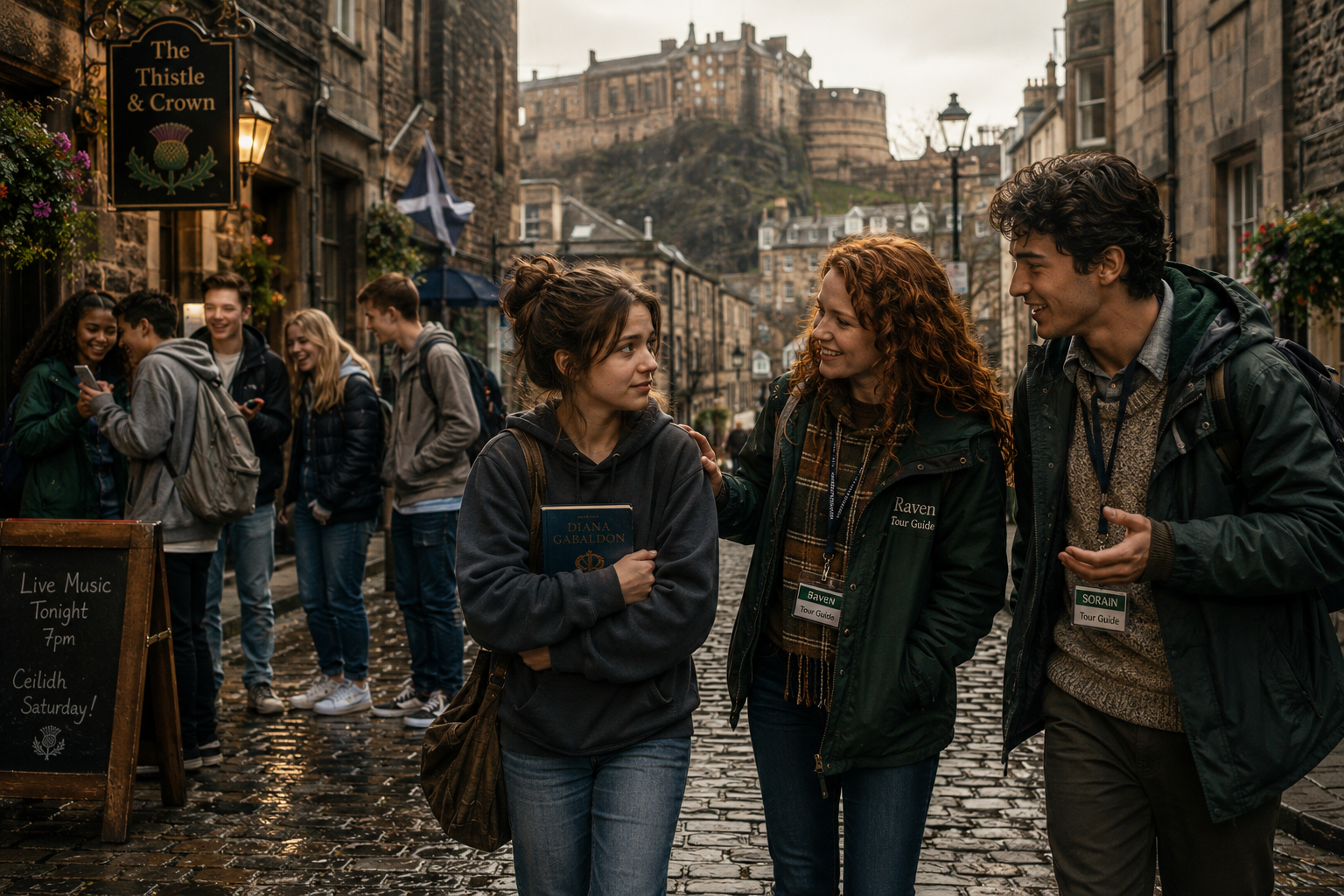
On the last full day we were in Scotland, we were allowed to explore in small groups. Of course, my classmates didn’t want me to tag along. After all the groups had assembled and started heading out, I went toward the stairs to go back to my room to read. A couple of the local tour guides saw me alone and intercepted me. Raven, our main guide asked, “Why no’ go and have a wee look aboot?”
I gave a half-hearted shrug, answering honestly, “Naebody wants me in their group. I’m used to it. I’ll just sit in a room wi’ ma book.”
“No, you will no’,” Raven said. “You’re wi’ us now.”
Sorain grinned, “Aye, and I know the exact wee spot wir headin’ to first.” Before I could protest, they led me out of the hotel and down a quiet cobbled alley into a quaint residential neighborhood far removed from the tourist crowds.
“Ryanne, have ye enjoyed Scotland?” Sorain asked as we turned down another street.
I grinned; despite the fact I was beginning to think I was being kidnapped. “I’ve no’ felt this comfortable in years,” I replied, allowing my full accent and speech impediment to come out, sounding more like the native Scots than before.
Both guides exchanged delighted glances when I let myself relax. Raven pressed against my shoulder with his, asking, “Are ye originally fae Scotland?”
The feeling of belonging had already started to take root but hearing him ask me if I was originally from Scotland made me feel like I had finally found my home. “Naw, I’m fae Arkansas, a state alang the Mississippi.” I looked around at the cottages along the road we were walking on. They were picturesque. I loved how each building was unique and homey in its own way. “Right, whaur exactly are ye takin’ me?”
Sorain laced her arm with mine, “I’m takin’ ye tae see Maggie.” I looked at her expectantly. She said it like I should know who this Maggie person was. She huffed, “She’s a seer roon here. I need tae find oot why ye sound mair like family than a Yank.”
I stopped cold. A seer. My mother had warned me that people in England and Scotland still believed in things like witches and psychics. She also told me that God wouldn’t like it if I allowed myself to be taken in by them. Exodus 22:18 thundered through my mind: “Thou shalt not suffer a witch to live.” I wanted to run. Both of them stopped, turned, and looked at me. Raven took a step toward me with his hand outstretched, “Ryanne, ye awright?”
I shook my head, not trusting my voice to be steady. I looked around more frantically, trying to find a way back to an area I recognized, but we were so far off the main roads that there was no way I’d find my way back on my own. “Naw, I’m no’ goin’ tae see a witch. Absolutely no’.”
“A witch?” Sorain laughed lightly. “Maggie’s no a witch. She’s a seer. She’ll tell ye why ye feel pure at hame in this place,” Sorain explained.
Her words did nothing to soothe my worries. “Ma mum’ll murder me if I went tae see somebody that thinks she can look intae ma soul or ma future or whateve’.” I took a few steps backward before they were by my side. I could feel the icy fingers of terror reaching into me.
Sorain could see the scared rabbit in my eyes, ready to run. “I swear ye’ll be safe. I’ll take ye back tae the hotel masel’. Just…come see Maggie, aye? I know she can tell ye why ye sound like that, why ye feel like one o’ us.” The pure honesty that radiated from her calmed me. There were warmth and certainty in her words. She felt like someone I could trust, like family. So, I nodded and allowed them to take me a few more cottages down the road and into the home of Maggie.
Maggie lived in a cottage that smelled of mothballs and old tea leaves. Everything inside seemed decades out of date. She herself looked as ancient as the house. Her hands shook as she brought in an old tea set that was cracked and stained from years of use. She was lovely with her cotton white hair shaped like a bulb atop her head, and the lines across her face made me think of my grandmother back home.
Maggie’s eyes were cloudy, yet when she looked at me, I felt utterly seen…to my soul. She served us tea, barely taking her eyes off me. “Back again, I see, a thasgaidh.” She spoke directly to me, as if I’d been there before.
I had never met her before or been in her home, but when I opened my mouth, I replied in a voice that felt both foreign and familiar, “Aye, my dear friend.” Then I clapped my hands over my mouth as if I could capture the words before they left. “Sorry, I didna mean to say that. I’ve ne’er been here in ma life.”
“But you have, a ghràidh, many times,” Maggie said. “You need to be awakened to know the truth.” Maggie’s rusty voice washed over me. I knew she wasn’t speaking strictly English, but I knew in my heart that she was calling me dear one. “Gie me your hands, a ghràidh.” She stretched out her leathery hands to take mine. Her skin felt smooth and soft. “Close ye eyes and listen with ye heart, a ghràidh. I know this feels peculiar, but ye’ll understand in mere moments.”
When I closed my eyes, I heard Maggie start to talk to me. At first, I wasn’t sure what she was saying, but as I relaxed and allowed myself to be taken away by the rhythm of her cadence, I started to realize she was saying my name. But it wasn’t Ryanne. She called out to “Fiona, Isla, Magaidh, Eilidh, and Rhona.” Each name was my name. I could feel them in me. They were me. Then their lives filled me; their memories rushing in like tidal waves.
I saw stone cottages battered by sea winds. I smelled peat smoke curling from hearth fires. I heard laughter in Gaelic and the cries of newborn daughters. I felt grief, joy, hunger, love, and longing. Five women. Five lives. Five versions of me. And beneath them all, the same soul.
My soul.
At last, I understood why Scotland felt more like home than anywhere I had ever lived. I had come back to this land. Again and again, and somehow, in this lifetime, I finally found my way home.
Opening my tear-streaked eyes, I greeted Maggie, whispering, “Hullo there, mo rùin. It is a grand thing to be seeing your face again.” Sorain’s and Raven’s eyes widened at the change in my demeanor and word choices. I felt at ease for the first time in a very long time. “It’s aw right,” I said, smiling through my tears. “I know why I feel at hame here noo. I’ve been born richt here for generations back. I jist missed this verra ane.”
Sorain found her voice first, “Ryanne, how the hell d’ye know Gaelic? Ye didnae even know it a minute ago!” Raven nodded along, confusion written across both of their faces.
Smiling, Maggie answered softly, “Cuz she’s ma sister. She deit pure young in her last life. She was always meant tae be in Scotland. Her hert still knew it, even when her mind didnae. I’ve just unlocked her memories o’ her past lives. If she doesnae do her duty, she’s bound to come right back here again.” Her cloudy eyes crinkled at the edges, knowing in some part that her sister was inside me. “She deit too young in her last life, same as the four afore that. Always afore her twenty-seventh year. She was meant tae be here, tae feenish the wark she began lang syne, but death jist kept stealin’ her awa afore she cud end it.”
A chill rippled through me. I looked from Maggie to Sorain and Raven, my throat suddenly dry. “What wark?”
Maggie reached across the table and covered my hands with her own. “That’s for ye tae feend oot, a ghràidh. But I know this much: if ye live past ye twenty-seventh year, the cycle will end. Ye’ll nae be sent awa tae start a-new. Ye’ll be richt here where your soul has always belanged.”
Twenty-seven.
The number echoed through me like the tolling of a cathedral bell. For fifteen years, I had believed my greatest struggle was learning to speak clearly enough for others to understand me. Now I understood that my voice had never been a problem. It had been a memory, a thread stretching across centuries, refusing to be severed.
Raven and Sorain walked me back to the hotel in reverent silence. The streets of Glasgow glowed beneath a lavender sky, and every cobblestone beneath my feet felt achingly familiar. At the hotel entrance, Sorain pulled me into a fierce embrace. “Ye’ll come back,” she said.
This time, I understood that she meant more than a return visit. I looked past them to the ancient city, to the land that had called to me across oceans and lifetimes. For the first time in my life, I didn’t feel broken. I didn’t feel strange. I didn’t feel alone.
I felt remembered. And for the first time, I had something more powerful than belonging. I had a purpose. I didn’t yet know what duty awaited me in Scotland, nor why fate had torn me away five times before I could complete it. But I knew one thing with absolute certainty.
I would return.
I would survive.
And when I reached my twenty-seventh birthday, I would finally stay. “Aye,” I whispered; my voice was steady and sure.
Deep within me, the voices of Fiona, Isla, Magaidh, Eilidh, and Rhona stirred like a chorus carried on the Highland wind. Not a welcome this time, a promise. “This time, you will remain.”